
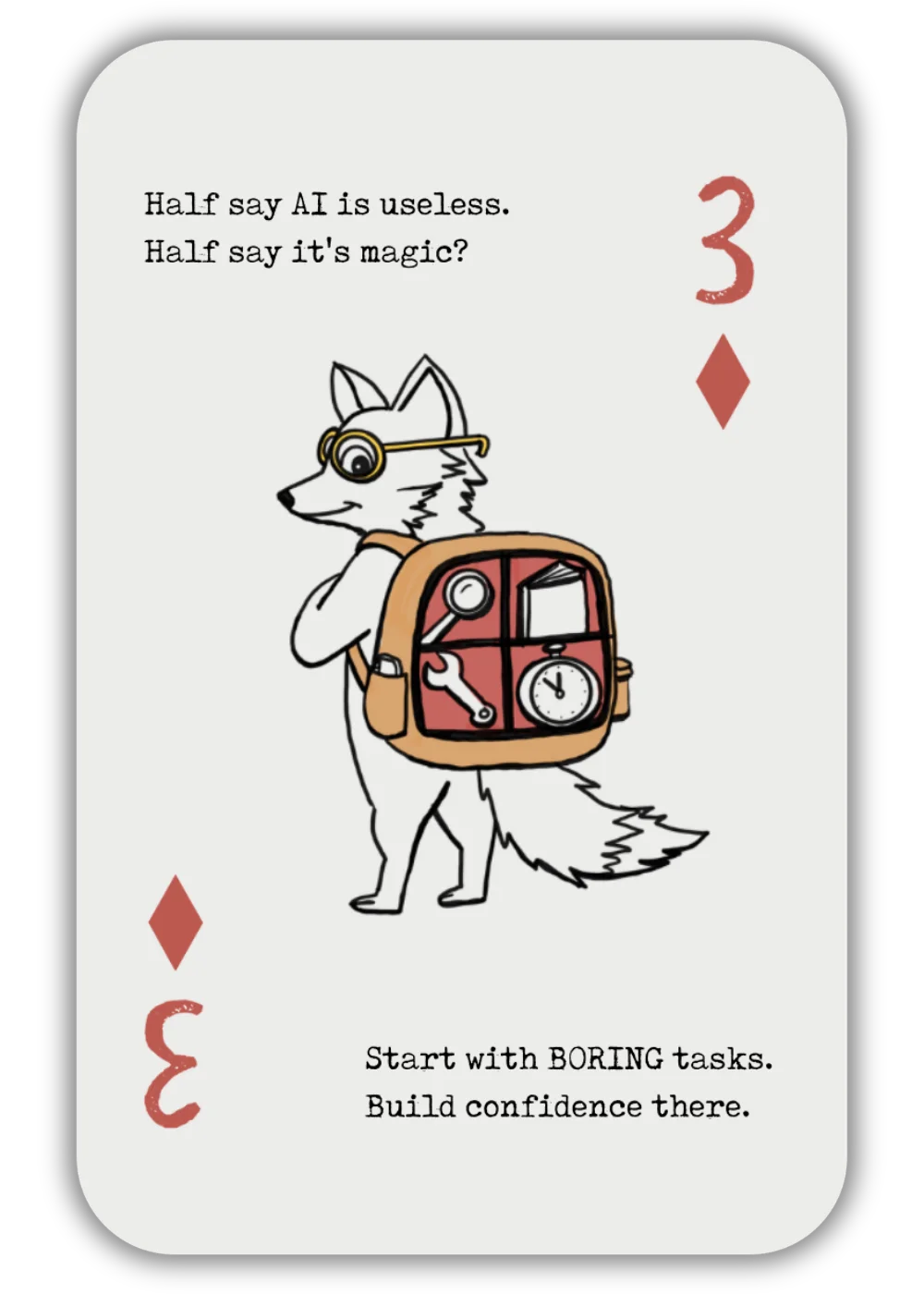
Half of what you read about AI tells you how amazing it is, and the other half how useless it is. How do you form your own opinion, confidently enough to justify (or squash) potentially significant investments into change in your company?
First of all, let’s dispense with some of the confusion by defining what we’re talking about here – current large language models, or LLMs. You know, the “glorified text guessing machines.” As of the time of this writing (early 2026), those, often unkindly labelled as “stupid, hallucinating” machines, are actually pretty powerful. I’d wager, about half of the statements you read on how useless they are, come to their conclusion either from lack of knowledge on how to leverage LLMs properly (which includes knowing and navigating around their weaknesses), or lack of understanding what to use them for – and what not to.
I will not get into philosophical debate about human creativity and the AI’s attempts to replicate it – I’m actually on the side of skeptics on this one. What I’m pretty bullish on, and what my cards are all about anyway, is the impact LLMs and their applications can have on business today. I find those undeniable, skeptic or not. “We can disagree, we can argue, but that’s about all that we can do about it.” (If you get this reference, PLEASE let me know).
What I see in businesses (including my own coaching practice) daily can be roughly grouped into four categories:
Access to knowledge – and skills
The most obvious. LLMs are trained on plenty of data out in the wide world, not all of it readily available by other means. Even if using say GPT just as a glorified search engine, the difference is already there (hell, I actually find Gemini’s – Google’s AI – suggestion on the search result page often quite helpful). But combined with the ability to imitate a specific person, reference a particular body of work, applying a specific set of knowledge and skills, literally everything out there is at your fingertips. The speed of learning has increased by orders of magnitude. Any expert, any time, on your speed dial. (yes, hallucinations could be an issue, but one fairly easy to mitigate with good prompting etiquette).
Increasing output quality (thoroughness)
There’s nothing AI can do that a human couldn’t do better – given enough time. Once we put the time as a constraint (and when it isn’t!), the equation becomes, how well we can accomplish something within that limit? AI is a force multiplier. Set an agent to do competitive research for you, while you are thinking through how you’ll use the data when it arrives. Use LLM as a thought partner to oppose you (they’re not as sycophantic as they’re blamed to be, you just need to ask nicely). Run quality check on your work from your browser extension. That is really just the tip of the iceberg.
Saving time – increasing productivity
Let’s call this one obvious, too. The boring tasks that we all hate doing and which are taking so much of our valuable time, are often the easiest (and safest) to offload to AI. With tools like Claude Cowork, all you need is the right mindset and eye for the tasks to hand off.
Custom tooling
We’re getting into the Vibe coding territory here. I don’t think AI is going to kill all software. However, what about systems trying to do a simple task for lots of people that is repeatable with proper prompts? Beware. Would I vibe-code a medical record system? Hell no. Now, what about a customized survey tool that does EXACTLY what I need for the application without any additional fluff? and monthly bill that includes me paying for all the functionality I don’t need – yup! Chances are, it will take less time to stand that up than it would to select a tool, learn how to work with it, and integrate it into my environment. The same can be true with things like time, inventory tracking, etc. AI truly can give you the tools that will work for you, rather than a software you have to adjust your behaviour to.
This is obviously only a handful of examples from my own practice and experience. Where do YOU think AI can help your business today?