

Are you looking for ways to unlock the creative energy in your team? To get more proactive and innovative in solving problems? Do you become frustrated with the effort it takes to move the conversation forward?
The problem (and the solution) may be in the language being used. Language has power, it forces us to think in a particular way. Just a small change in wording will greatly change the impact of what we are saying, and the way it is perceived. Here are a few examples of some powerful words, both good and bad.
But
The “but” is one of the most damaging words to ever enter a sentence. We can see it coming from a mile away. It flips the meaning of what was just said, and it sucks energy from the conversation. Just think of the famous “Yes, and” rule of improv, and imagine (or try) to say “but” or “no, but” instead. You’ll see how quickly the exchange grinds to a halt.
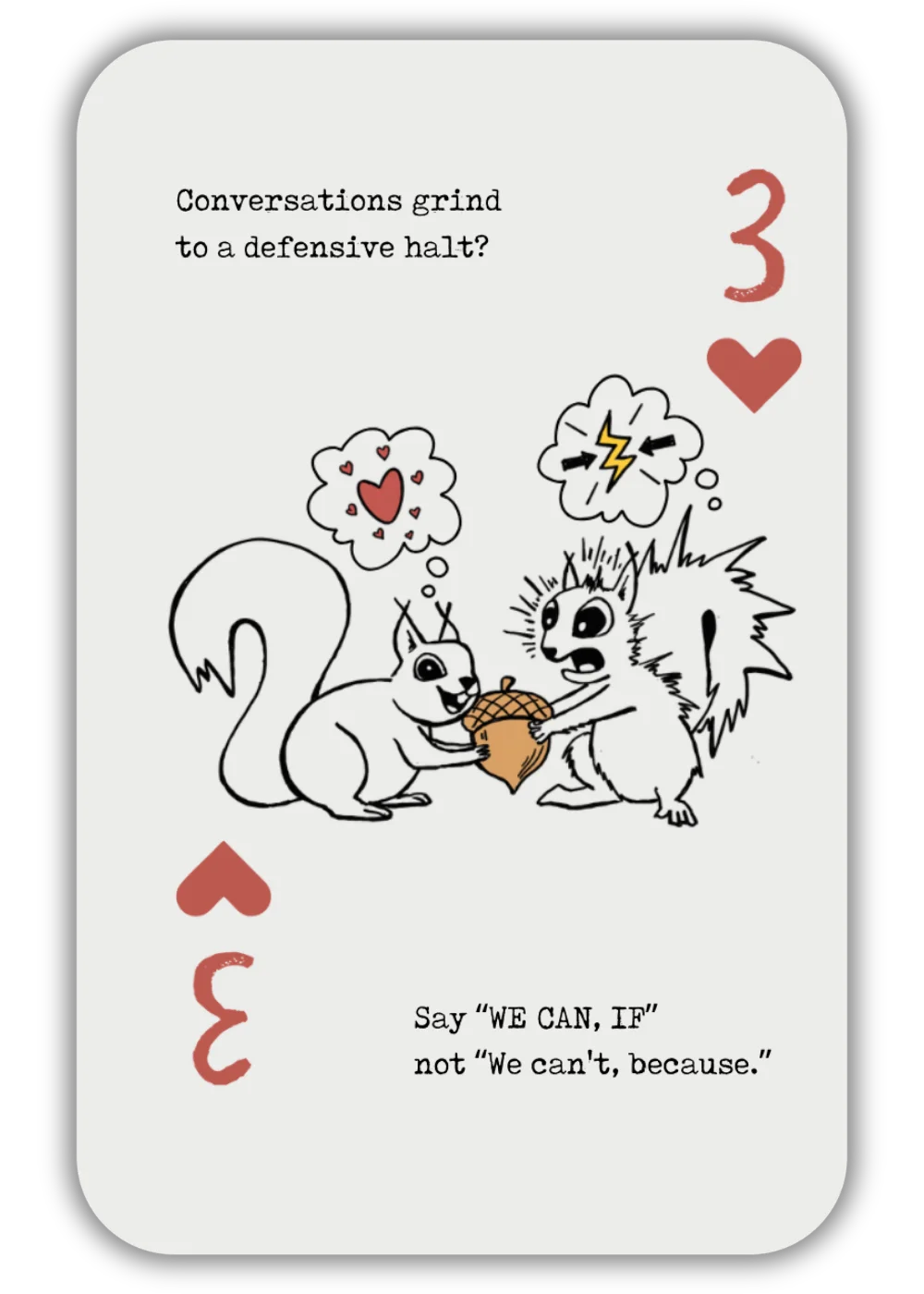
Can’t, because …
A sure way to anchor you in a limiting mindset.
“We can’t do it because…”
It takes you and your team to a depth, to a dark place of defensiveness. Once in that limited thinking, you then have to work to claw your way out of this hole collectively, to even continue working on the problem.
Can, if …
This expression is the antidote to the poison of “can’t.” This phrase explores, in other words, what would need to be true in order for us to achieve something? “Can, if…” forces us into creative mode. I’ve been using the adage “what needs to be true?” approach to thinking a lot. Then, an amazing book, A Beautiful Constraint, introduced me to the magic of “Can, if…”. Do yourself a favor and read it.
You
What’s wrong with “You”, you ask? It all depends on context. “You make me…” for example triggers fight or flight reflex in your conversation partner, rather than inviting them to collaborate with you. So, be mindful of the context when reaching for that particular start to a conversation. Check out the S.A.F.E. method for some helpful hints.
Speaking of mindfulness, be aware of possible cultural differences. Depending on our culture of origin, and our first language (especially in the case of us ESLs), the same word can land very differently than intended. Just think of the word “conflict”, for example. Someone can fill in “healthy conflict”, as a legitimate way to reach a desired outcome. Someone else will feel the threat baked into the word and perceive conflict as something to be avoided at all cost. Always seek clarity when you feel like your words are not landing the way you intended, or if someone else’s words are triggering a reaction you don’t feel comfortable with.
Are you deliberate in the language you use?