

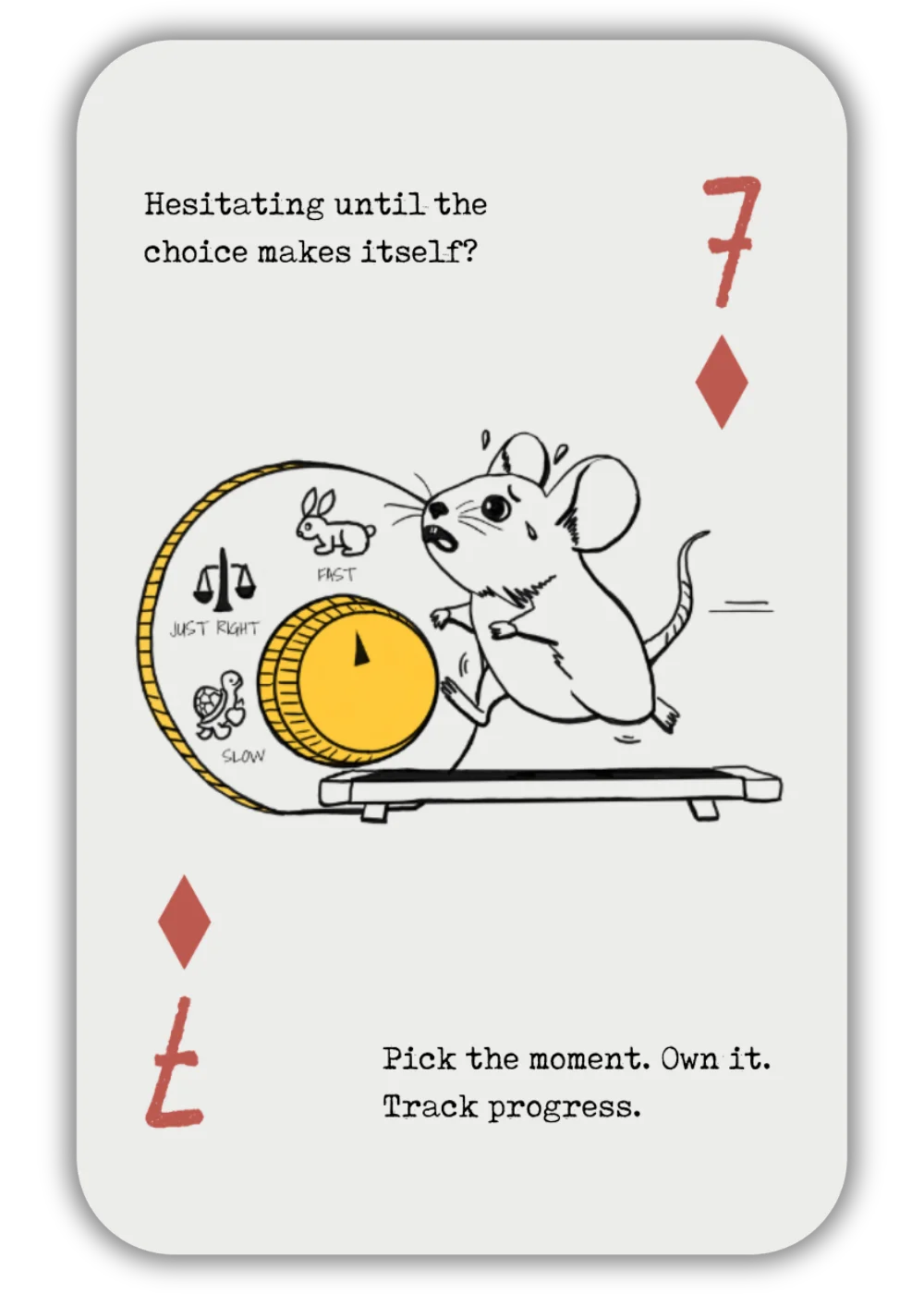
When do you need to speed up, and when should you slow down instead?
Recently I made the case for “Slowing TF down.” Let’s talk about the opposite today – when too slow is just, well, too slow.
However, what I’m really calling for is balance. Too fast can be nearly as damaging as too slow. In fact, sometimes procrastination has a point – but we nearly never know that in advance.
I’ve watched a leadership team with combined salaries of a thousand bucks per hour spending a total of maybe two hours over several meetings on an issue with maybe $2k impact (if that). While it does sound like a break even, we need to ask – what is the opportunity cost? What would you, as a shareholder, expect such a team to produce during the same two hours?
I’ve heard an ambitious “top” priority being proclaimed that sounded eerily familiar. Oh yes, there was the same exact one for the quarter before, and for the quarter before that, too, only worded slightly differently! Yet not much has been done towards completing it to date.I knew that if we left it as is, we would have the same conversation the following quarter, too. It had sufficient excuses already built-in, no creativity required.
I’ve witnessed countless decisions being kicked down the road – to the point of no return, to the point when the resulting action was either forced or completely meaningless.
But enough of the doom and gloom. How can we actually find that elusive point of “just right” between rushed and too slow?
Decide how to decide. What information, background, context can we get before the decision needs to be made, to balance its impact and chances of being the right one? Who needs, and who doesn’t need, to be involved?
Recently I find myself using the word “deliberate” a lot, and it applies here too.
So first, when does a decision need to be made for maximum impact? I’ve been using a simple tool with my client teams. Vertical axis is the impact, and the horizontal is time to decide/act, expressed logarithmically – today, this week, this month, this quarter and beyond. (quick template for download here). Sticky notes on a wall work great, real or virtual.
This practice helps to prioritize everyone’s time. It shows the interdependence of time and impact – sometimes. The same action will have different results based on when it happens – and sooner is NOT ALWAYS better!
Give each issue an owner. Grant them the power to make the final call, and clarify what a good outcome looks like. Give them the opportunity to request help and resources.
Then, track the progress. That’s it. Spend some mental energy on deciding how to decide, and you’ll make better, more timely and impactful decisions.
What are the decisions or actions that you seem to be hesitating on?