

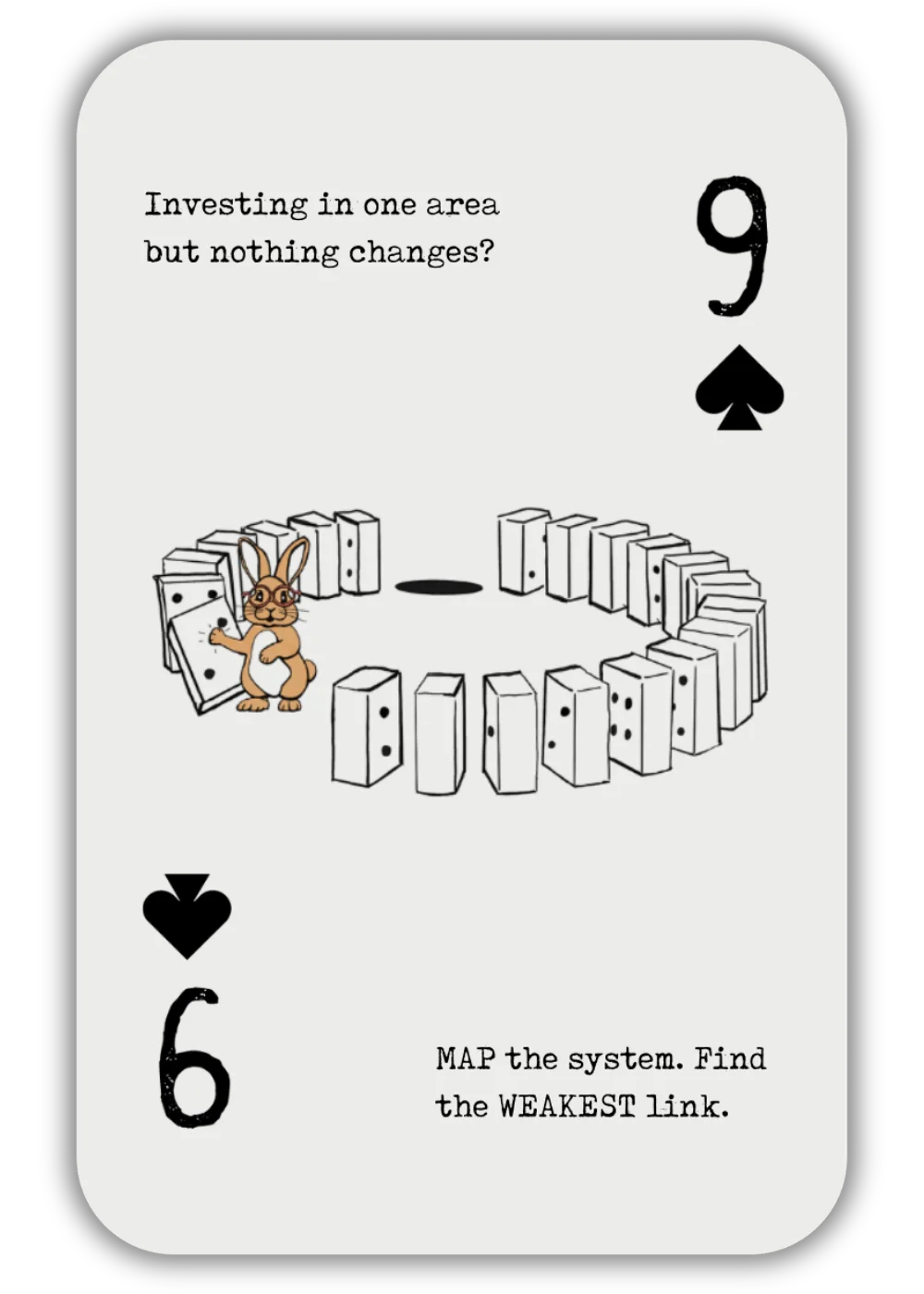
How do you know where in your business you need to put the effort next? Which is the next lever to pull?
The answer to this question is often less obvious than we would like. As a result, we can find ourselves investing in a part of our business, maybe even improving it dramatically but without any proportional effect on the business as a whole.
The most common, albeit far from the only, example is pouring all attention – and possibly all available funds – into the sales organization (“That will grow revenue, right?”) without considering the interdependencies. Are the sales people set for success? Are they fighting an uphill battle because of our product reputation? Are we using new sales to compensate for high churn? Do they have to educate the prospects first as there is no product marketing or demand generation in place?
While there are quite a few frameworks able to help unravel the mystery and point to the area requiring the most effort, the three that come to mind right away have something in common – they all end up depicted as a kind of circle, loop, or cycle. Further, they use similar concepts – understanding steps along the way, and repeatedly testing each of them in order to find the weakest link.
The Flywheel
The first one is Jim Collins’ Flywheel. Its blocks are activities or achievements that when one is perfected, make the next one inevitably better as well. Jim makes the argument that the secret sauce of each great company is not in one thing they do well, but in the understanding of what makes “their” flywheel spin, and what are the friction points. He wrote a great monograph, “Turning the Flywheel” – a tiny booklet explaining the tool as well as the step-by-step process for discovering your own.
The KFFM
The KFFM (or Key Function Flow Map), is a key (duh) Metronomics concept. It chains the functional areas of the company which contribute directly to the company’s output, and assigns them both ownership and measure of success. Outputs of one, act as (measurable) inputs for another, and the measures become metrics on the respective leaders’ scorecards. It offers a critical analysis in what makes the business tick, and where the weak spots may be hiding. Dig into The 3HAG way or Metronomics to learn more. The clarity KFFM provides is incredible, every time.
The Value Chain
OK, the Value chain does need a feedback loop (often in the form of referrals) to wrap around, and most depictions are linear. So forgive me for including it here – I couldn’t live with myself if I omitted it. It maps the steps on the customer’s journey, from learning about us to paying their final bill – and hopefully providing reference for another customer. We note whether or not a customer receives or gives up value (money, time, effort, solution to their problem), as well as what both we and they need as an outcome of each step to proceed to the next one. Thales Teixeira’s “Unlocking the Customer Value Chain” is a great book on the topic.
I’m sure you can see the similarities – and differences. The common principle lies in breaking the business into manageable, well defined pieces, and exploring how they affect each other and the system as a whole. The three tools use different ways of how to achieve that, yet each one of them provides an invaluable insight. Over time, we often end up using all three of them at different points for clients, deepening the understanding of the business as we go.
How well do you understand what makes your business tick today, and what is the main bottleneck to its growth?