

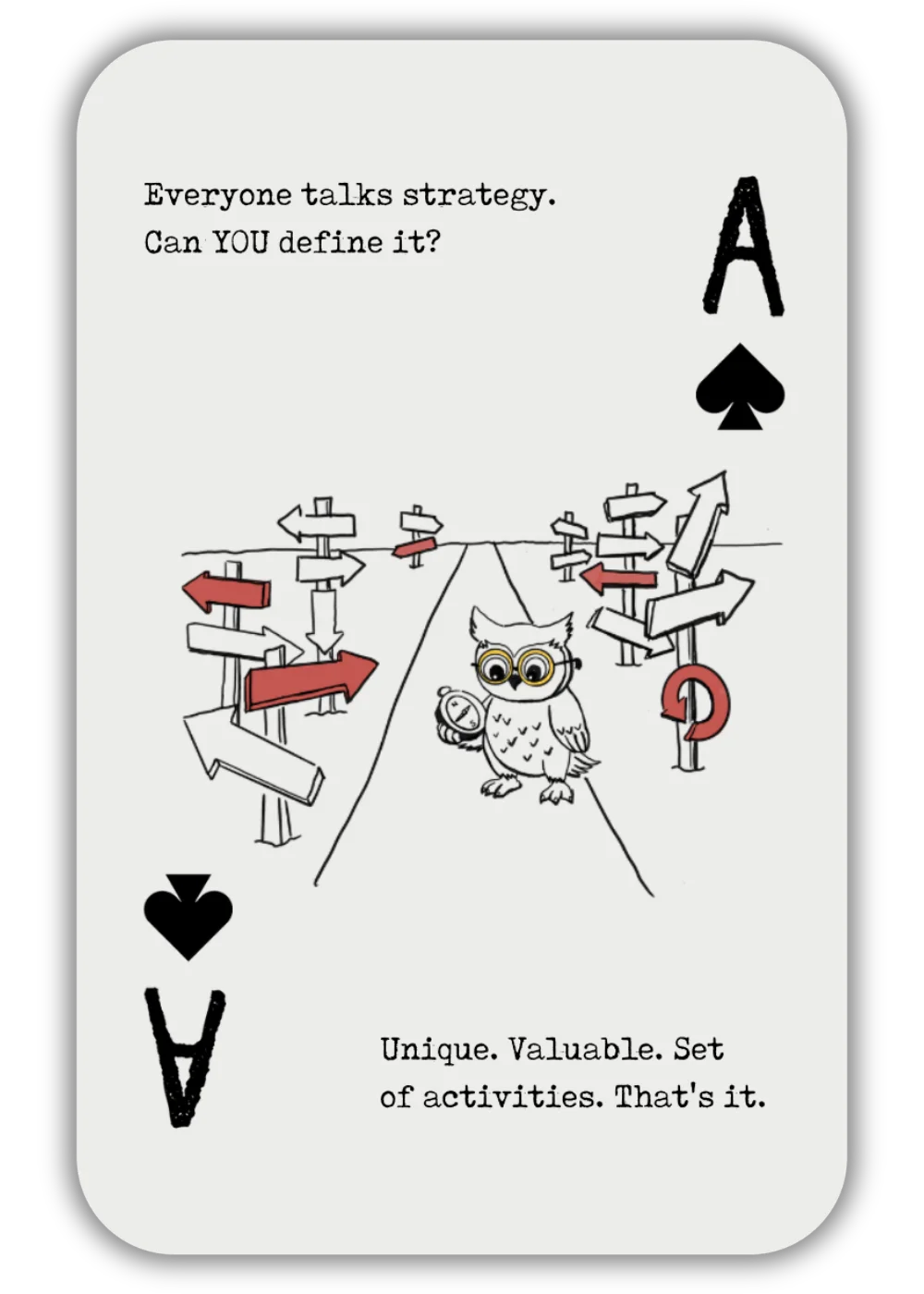
Amongst the most frequently misused words in business conversations, “Strategy” undeniably reigns supreme. Everything is “strategy,” yet asking the question “What is your strategy?” rarely yields a good answer. At best you hear a plan. More frequently, only the next step thereof. Sometimes you get just a subset – a “marketing strategy,” perhaps. Disturbingly often, you get a blank stare, even from a seasoned CEO. Asking a team to describe their strategy independently is often even more deflating. I once received seven different answers – from a team of six.
In one of our CardCast episodes, Ged recalled a CEO answering that question with a version of: “We’re going to hire….”
The problem starts with a lack of understanding of what “Strategy” actually means. For the benefit of clarity, when using the word “strategy” going forward, I (along with the rest of Metronomics coaches) adopt Michael Porter’s definition: “Strategy is the creation of a unique and valuable position involving a different set of activities.” I find his definition particularly useful, because it highlights the key components of a good strategy.
So, let’s break what this means down.
Unique
What is it you do differently? Compete to be unique, not best. Define your own dimension. Find the white space. It may be in combination of services, temporal, geographical…doesn’t matter, as long as it is yours.
Valuable
Why would someone care? Just because something you make or do is cool, doesn’t mean it will sell. Understand your value proposition. Know your core customer. Feel THEIR pain. Fall in love with THEIR problem. Don’t create a solution in search of a problem, or, for the love of everything that is Holy, do not CREATE a problem for the customer just so you can solve it.
Set of Activities
Does what you’re planning advance your strategy? Strategy is not a single action. It is a guiding principle that determines which actions to take – and, sometimes more importantly, what should be left in the dust.
Strategy is not what you want to do next – it is a framework to help you decide what deserves your time.
Strategy is also not fixed – it evolves in time, the link between strategy and execution is always bi-directional. Strategy directs execution. Execution validates strategy and its underlying assumptions. A great company needs to excel in both (AND culture, of course). Statements like “execution eats strategy for breakfast, are, well, bovine excrement.
Metronomics and its 3HAG principle guides the setting and evolution of strategy with a combination of tools addressing those very aspects. Now, even without a framework, just making sure you have solid answers to those three questions which sets you well ahead of the pack.
How clear (to you and your team) is your strategy? Does it check the above boxes?