

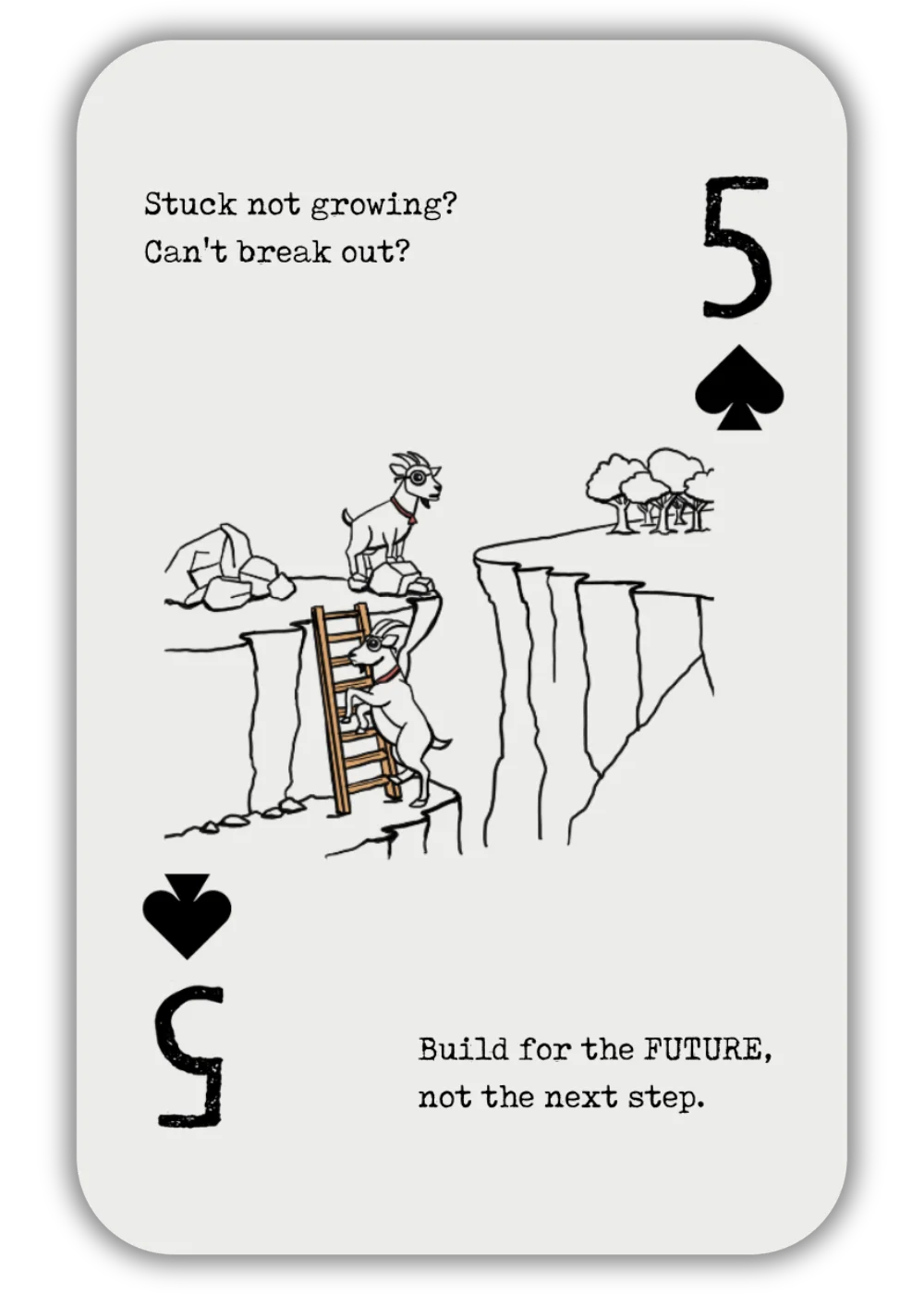
Why do some companies make it, and others don’t? So few reach a million, even fewer five, and the unicorns are, well, almost as rare as the real unicorns.
The proverbial (first) Valley of Death sits at the $0.5M – $2M in revenue. Out of the companies that make it to its precipice, only a selected few emerge on the other side ready for the next leap.
Clearly, it is not impossible to get through, but why is it so hard for so many?
Often, the company entering the new value bracket is just not built to make it through, and needs to reinvent itself.
What gets you to a million will often not sustain you beyond two, let alone five.
The issue is many founders build not for the future, but for the next immediate challenge. “Let’s get to a million, and then figure out the way forward.” Look at the following example to see how that often fails.
A small consulting business can prevail on referrals alone. They only need to do a few jobs right, and the clients keep coming back and often enough bringing new ones with them, which keeps the business humming. This means, there is very low customer acquisition cost, prices can be relatively moderate, and productivity and delivery value high. Almost every hour is billable.
Try to scale this beyond a particular point, and what happens? Suddenly, to produce the same output per client, the amount of non-billed time (spent on sales, training of new people, marketing, management of larger teams, etc.) starts creeping up. The complexity of the business goes up and overall productivity tanks.
The pricing model no longer works. Now, what if the pricing is what made the company successful in the first place? “Hey, we’re so much better than the big guys, and we can do the same for a fraction of the cost – and still make money for ourselves.” That competitive differentiation dies the second we want to become one of the ‘big guys.’
One can get quite far on founder-led chaos, but at some point, a limit is reached and the company inevitably hits a plateau. Suddenly, a total reinvention is absolutely needed across the whole system – value proposition, core customer, its own architecture, leadership, internal systems, etc. Such reinvention is expensive, often prohibitively so. I’ve seen companies spend precious capital and time trying to get through those invisible barriers just to retreat, lick their wounds, and try again a few years later.
The only way to avoid this pain and reduce the risk is to build for the future you want.
That means early on you may not be making the decisions to get you to five million the fastest, but those that will get you to hundred million the fastest. Those will not be the same.
You will deliberately choose to slow down in the beginning, doing things right. You will prioritize hiring people that have the capacity and maturity to grow with the organization, so you reduce the need of swapping them later. You make sure they have the support along the way to promote scalable, sustainable growth.
You replace systems early, and invest in their future capability. You ensure your foundations are solid. You test that your value proposition is compatible with your desired scale.
All in all, you are deliberate and proactive. You drive and control your growth, rather than constantly playing catch-up with your own success.
Then there are no big valleys, just a steadily rising road. Not without bumps and potholes, of course, but definitely without unforeseen unabridged canyons.
What company are you building, regardless of where you are on that journey?